Raising a Less Anxious Generation
I was an early believer in technology.
I didn’t just adopt it, I helped build it. My first iPhone felt like an extension of my mind. It amplified my work, my creativity, my social life. I overused it, learned from it, and eventually found 'balance'. I assumed that was the natural arc: fascination, excess, correction.
That assumption turned out to be wrong.
Children are not early adopters in miniature. They are developing nervous systems. Childhood and adolescence are periods of rapid brain construction, in which attention, emotional regulation, impulse control, and social confidence are shaped by repeated experience. These systems are highly plastic—and therefore vulnerable.
Over the past fifteen years, we replaced a play-based childhood with a phone-based one. At the same time, rates of anxiety, depression, self-harm, and loneliness among adolescents rose sharply across Western countries. The timing is striking. The pattern repeats across datasets. And alternative explanations—poverty, violence, academic pressure—fail to account for the shift.
The mechanism is increasingly clear.
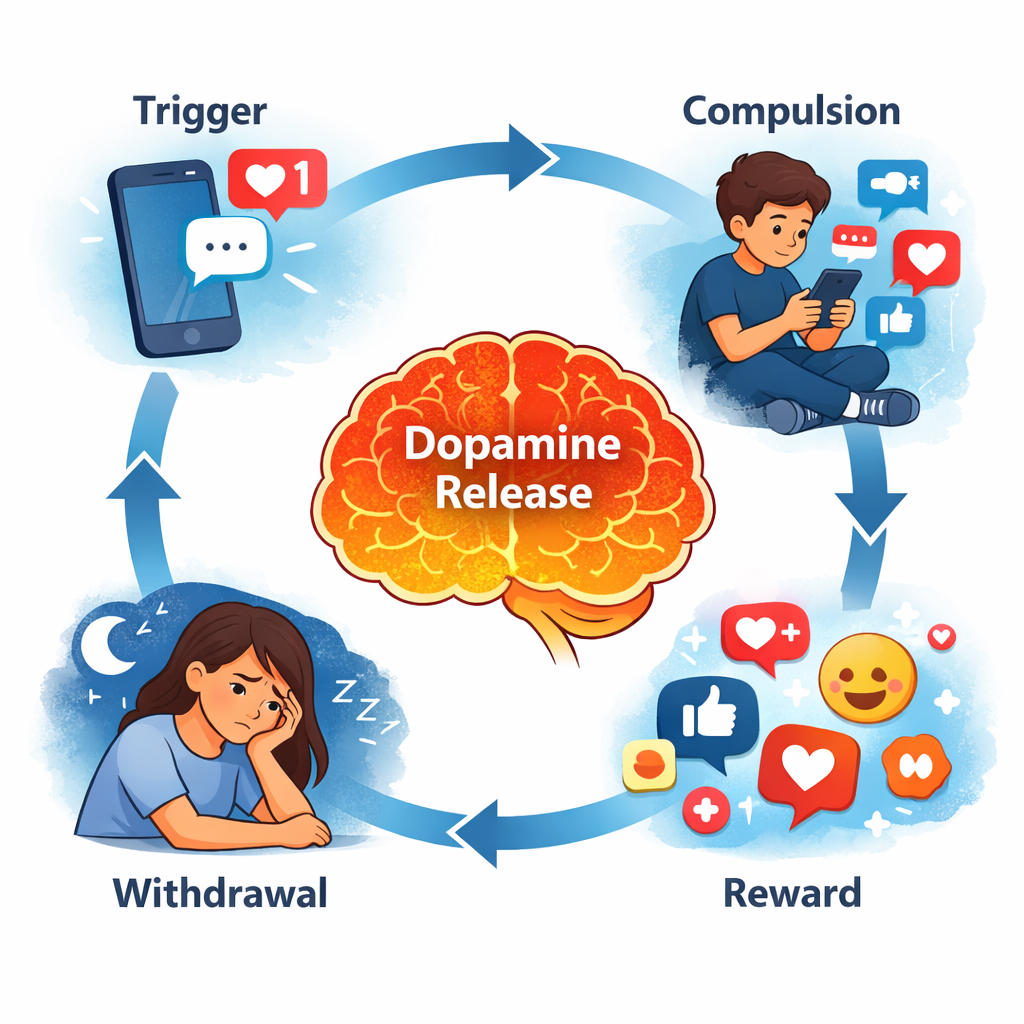
Smartphones and social media train the brain toward constant social evaluation, intermittent reward, and heightened threat sensitivity. Dopamine systems become tuned to external validation. Fear circuits are activated again and again. All of this happens before the brain’s regulatory systems are fully developed. The result is not resilience, but fragility: a nervous system optimized for avoidance, comparison, and reassurance.
At the same time, we inverted protection.
In the physical world, children are increasingly supervised, scheduled, and shielded from risk. In the digital world, they are given near-total autonomy—exposed early to adult social dynamics without meaningful guardrails. We removed the very experiences that historically built competence and replaced them with frictionless stimulation.
I saw this most clearly with Amélie.
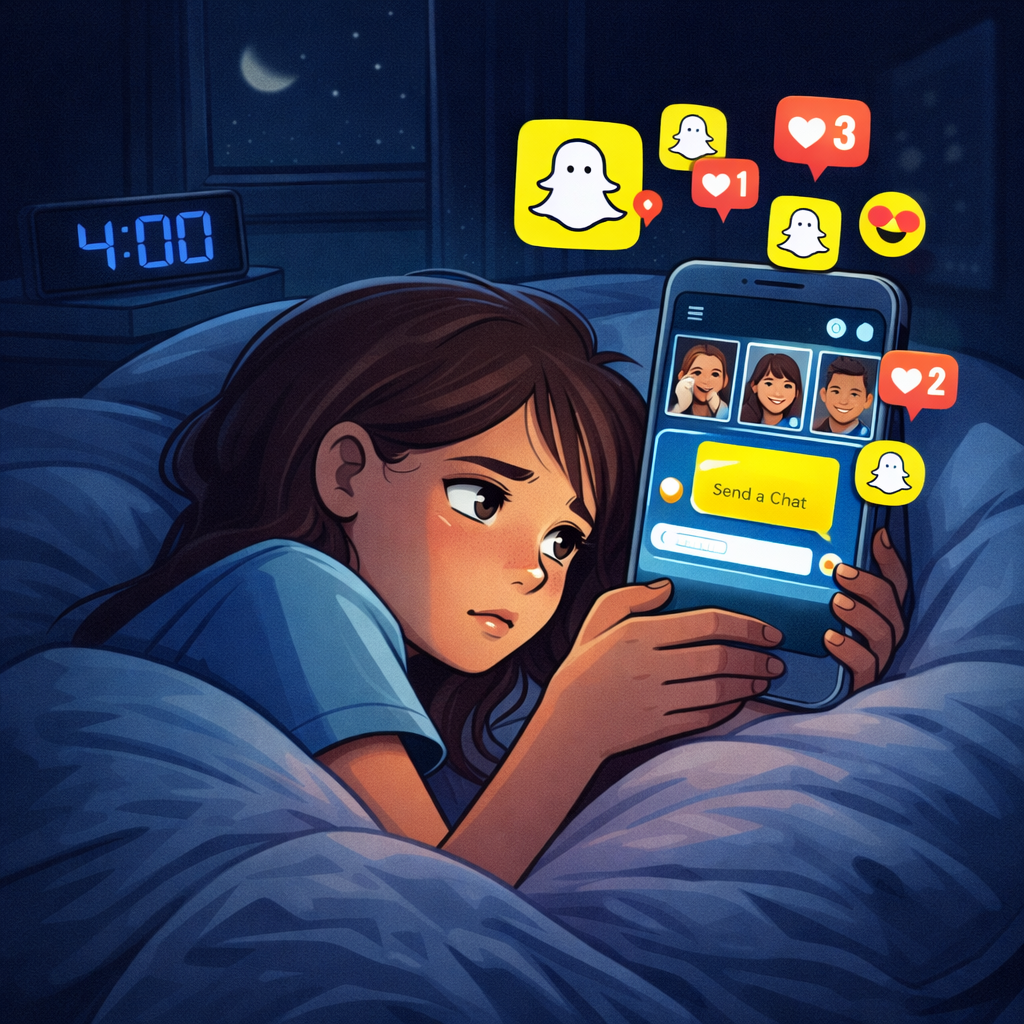
When she was around fourteen or fifteen, there was a period when she became persistently cranky and exhausted. I couldn’t quite place it. Nothing dramatic seemed wrong. Eventually, I checked her Screen Time data and the pattern was obvious: she was on Snapchat with three friends until four in the morning, every school night, ying in bed, phone in hand.
She wasn’t doing anything extreme. She simply didn’t want to miss what her friends were talking about. Pure FOMO. The result was chronic sleep deprivation, and during the day she was running on fumes.
What struck me most was that this wasn’t unique to her. All four girls—and their families—were experiencing the same thing. No one wanted this. Every parent would have preferred their child to sleep. But no single family could fix it unilaterally. If one girl logged off early, she was simply left out.
This is what Haidt describes as a collective action problem.
Individually rational decisions—stay online so I don’t miss out—produce a collectively irrational outcome: exhausted children, heightened anxiety, and worse mental health for everyone. The problem cannot be solved by willpower or good intentions alone. It requires shared norms and coordinated boundaries.
This is why structural solutions matter more than individual parenting hacks.
I see the same tension play out with my kids.
Eli has been biking to soccer and tennis by himself since he was ten. A twenty-minute ride through the city. At first, we tracked him obsessively using Find My, watching the dot move across the map. It felt responsible. In reality, it was mostly about managing our own anxiety. Over time, we stopped checking, not because the city changed, but because he did.
Once I caught him at McDonald’s during school recess. Privileges were taken away. More importantly, we talked; about freedom, trust, and consequences. These moments aren’t failures of parenting; they are how values get aligned. Agency grows through calibration, not perfection.
When Amélie later went on her gap year, Find My played a similar transitional role. Useful at first. Reassuring. Gradually irrelevant. Letting go turned out not to be a single decision, but a series of small ones, each based on growing competence rather than fear.
Mika complicates things further. He sometimes turns off his location services when skipping school or going to an illegal party. I know this. And while it’s not ideal, I understand it. Adolescence without secrecy isn’t adolescence; it’s compliance. Total surveillance wouldn’t make him safer. It would only make him better at hiding. What matters is that when things surface, we can still talk, and consequences still exist.
These experiences sharpened how I read Haidt’s core prescriptions.
Phone-Free Schools
Schools exist to cultivate attention, learning, and social development. Smartphones undermine all three.
Even when unused, phones fragment attention and keep the peer group permanently online. Comparison, status, and social anxiety are never fully absent. No individual child or teacher can out-compete that pull.
Phone-free schools are not restrictive; they are developmentally protective. They restore sustained attention and give children relief from constant evaluation. Just as importantly, they solve a collective action problem: no single child has to opt out alone.
Free Play and Real-World Agency
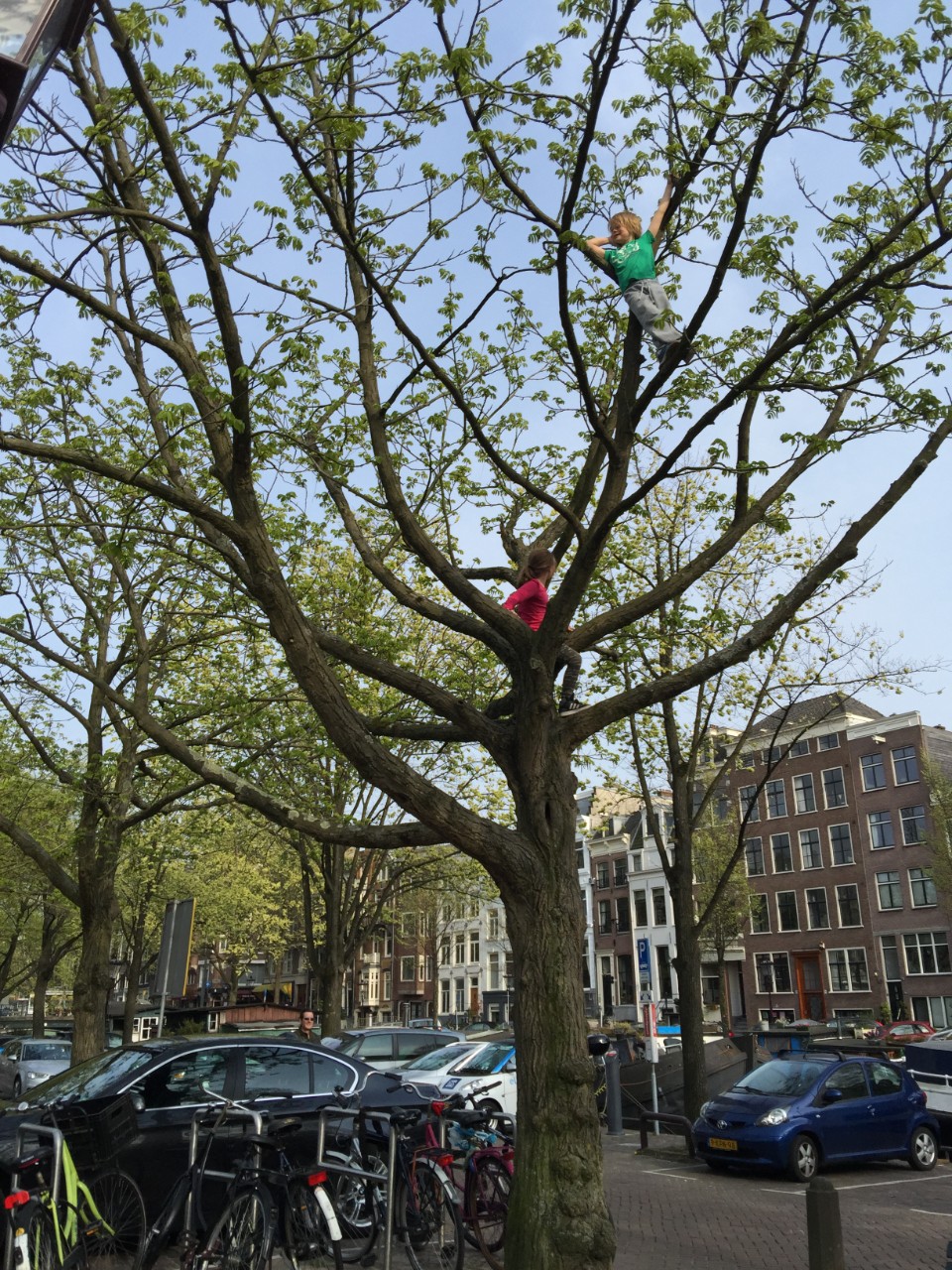
Children need unsupervised time in the real world to develop competence.
Free play, without adults directing, rescuing, or optimizing, is how children learn to assess risk, resolve conflict, cooperate, and recover from failure. It is how agency forms: the internal sense of I can handle things.
When we remove these experiences, we do not make children safer. We make them less capable.
As parents, this requires us to regulate our own anxiety first. Monitoring can be useful early on. Boundaries matter. But scaffolding is meant to be removed. Surveillance cannot be the endpoint.
I've always loved this video of the Ted Talk of Gever Tulley about the importance of tinkering and play.
Screens remain the hardest boundary in our household.
We use Screen Time with all the kids, and it has been a constant negotiation. What helped was shifting from rigid rules to context-aware boundaries: no screens during school hours to encourage playing together; no screens right before bed or immediately after waking; and clear windows where screens are allowed—and therefore compete directly with other activities.
That scarcity matters. It makes trade-offs visible. Choosing screens means choosing not to play, build, wander, or be bored. The decision becomes conscious, and therefore educational.
What The Anxious Generation ultimately argues—and what parenting has confirmed for me—is simple but uncomfortable: mental health does not grow from comfort. It grows from competence.
If we want a less anxious generation, we must give children back two things we have quietly taken away: their attention and their agency.
That means fewer phones in schools, more freedom in the real world, and parents willing to step back once scaffolding has done its job.
Everything else follows from that.
P.s. It’s worth noting that The Anxious Generation has sparked debate.
Some critics argue that the evidence is correlational rather than strictly causal, or that the picture is more nuanced across cultures, personalities, and types of screen use. Others worry about moral panic, nostalgia, or oversimplification in a complex mental-health landscape.
Those critiques deserve to be taken seriously.
But they do not erase the central insight of the book: that childhood is a sensitive developmental period, that attention and agency matter profoundly, and that we have reshaped children’s environments faster than their nervous systems can adapt. Even if smartphones are not the single cause of rising anxiety, the convergence of evidence suggests they are a significant one—especially when combined with reduced free play and diminished independence.
We do not need perfect certainty to act. Parenting, education, and public health are always about decisions under uncertainty. When the potential costs of inaction are high—and the proposed interventions are low-risk and developmentally sound—waiting for flawless proof is itself a choice.
If we are wrong, phone-free schools and more free play will still give children better focus, stronger bodies, and more confidence. If we are right, the stakes are far higher.