---
title: "Beyond faster: helping entrepreneurs build"
description: "Most of the founders I talk to are using AI. Almost none of them are building with it."
url: https://www.mathys.to/writing/blog/beyond-faster-helping-entrepreneurs-build-24722/
section: blog
published: 2026-11-25
last_updated: 2026-11-26
---
# Beyond faster: helping entrepreneurs build
*Most of the founders I talk to are using AI. Almost none of them are building with it.*
That gap is what this post is about. And it ends with something I haven't done before on this site: an offer.
Helping entrepreneurs is something I've always done. Thirty years of building my own companies, and alongside that, other people's: founders at my kitchen table, in accelerator programmes, on the phone at odd hours. The conversations used to be about the usual things. Focus. Hiring. Whether to raise. Why the thing you built isn't the thing customers want.
This year a new question showed up in almost every session, usually about twenty minutes in, said a little quietly: "We're using AI. Are we doing it right?"
# Faster is the warm-up act
When I ask what they use AI for, the list is always the same. Writing faster. Summarising faster. Answering support tickets faster. Closing the books faster. And, a bit further down the list, the work nobody wanted in the first place: the bookkeeping, the follow-up emails, the reports that exist because someone once asked for them. Handed off to a machine, finally. All real. All worth doing.
That's efficiency: the same work, faster or without you. It's the first thing everyone reaches for, because it's the easiest to see and the easiest to justify. Nobody gets fired for making the inbox quicker, and nobody misses doing the admin.
But efficiency has a ceiling. You can only make existing work so much cheaper. And while everyone is busy doing that, the bigger shift goes unnoticed: the cost of trying something new has collapsed. Not by a bit. By an order of magnitude.
I wrote about this in [The Scarcity Filter](https://www.mathys.to/writing/building/the-scarcity-filter-24685/). For twenty-five years, expensive developer time decided what we even dared to put on a roadmap. Small ideas, personal ideas, speculative ideas died before anyone said them out loud. That filter is gone. Most companies haven't noticed yet, because they're still looking at AI through the efficiency lens.
That's where the real innovation sits. Not in doing Tuesday's work faster, but in the things you never let yourself start.
# Twenty-five things later
I didn't learn this from reading about it. I learned it by building. This year I built twenty-five things, from idea to working product, with AI doing most of the typing. Four of them:
[Kairos](https://setmeet.ing/), a scheduling tool with its own CRM. You say who you want to meet, it finds the moment and knows the person. The scheduling tool I'd wanted for ten years and never commissioned, because who builds a CRM for one person?
[Amy](https://amydala.app/), a notes app on speed. Two thousand three hundred thoughts, searchable by meaning and by the place I wrote them. I left Evernote and built the replacement from scratch.
[AirBuild](https://airbuild.tukew.com/), build tooling for the AI coding era. Your AI writes the code, your Mac builds it, the app lands on your iPhone. Infrastructure I needed myself, so I made it.
JaWeetIk, a learning game for my daughter. Times tables as an expedition across an island. Spaced repetition underneath, a theme she picks on top.
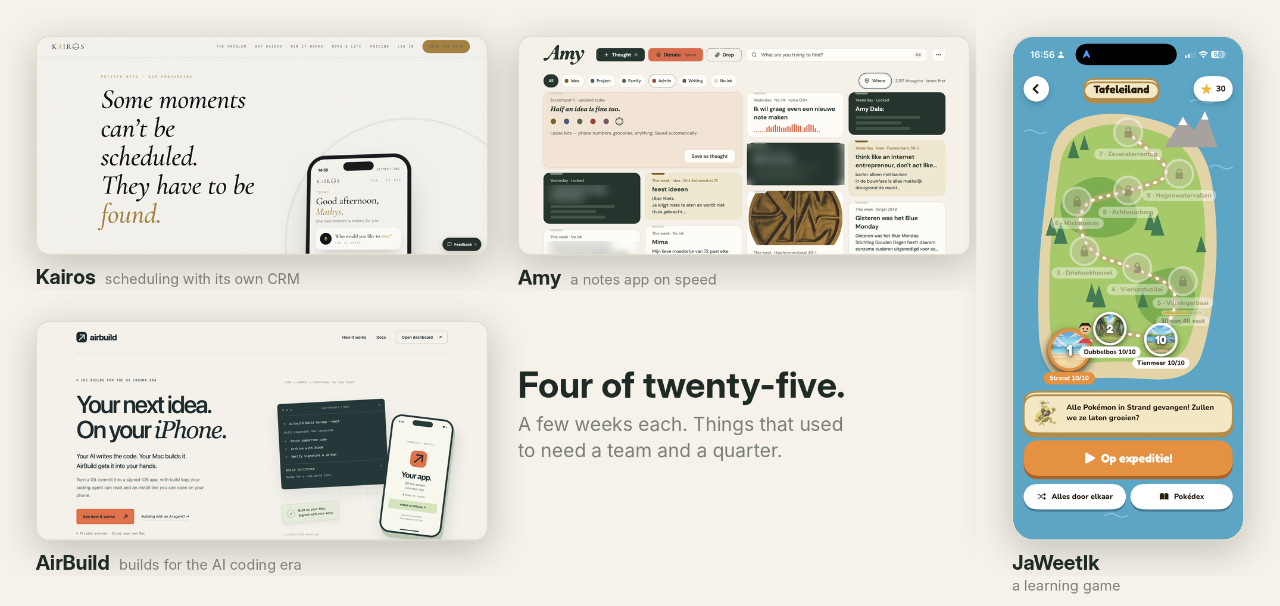
A few weeks each. Things that used to need a team and a quarter.
None of these would have passed the old filter. A CRM for one person, a notes app for one person, a game for one child. That is the whole point. When trying costs almost nothing, the question changes from "can we afford this?" to "what do we actually want to exist?" And the answers to that second question are where new revenue, new products and new positions in a market come from.
Here is what changed, drawn. The neck of the funnel used to be filled with work that never challenged anyone: setting up infrastructure, wiring libraries, creating accounts, writing the emails, running the audits, keeping it all alive. In most development budgets that stack ate more time and attention than the actual idea. It now comes off the shelf. What's left in the neck is the one thing that doesn't: judgement about what to build.
That's the shift I want to help entrepreneurs make. Not from slow to fast. From efficiency to innovation.
# Why advice is no longer enough
Mentoring works when the bottleneck is judgement. Which customer to chase, which feature to cut, when to say no. Thirty years and about thirty companies gave me a lot of judgement to share, and I'll keep sharing it.
But this year the bottleneck moved. Founders don't lack ideas and they don't lack judgement. They lack a working thing in their hands. A prototype they can put in front of a customer next week instead of next quarter. And no amount of advice produces that. Building does.
So I noticed myself doing something new in mentoring sessions. Instead of saying "you should test that", I'd open my laptop and we'd test it. Right there. By the end of the hour there would be a rough version of the thing we'd been talking about. The conversation changed completely. You can argue about an idea for months; you can only argue about a prototype for about ten minutes before someone says "let's just try it with a customer".
That's the work I want to do more of. Not instead of mentoring. On top of it.
# What I'm offering
I'm starting with three companies before the end of the year. Not a course, not a workshop about what AI is. Hands-on work on your business, for as long as it takes to make building a habit. Usually that's six months to a year.
1. **Look wider**. Half a day with you and whoever else matters. We map where AI could open something new in your business, beyond doing today's work faster. New products, new services, new ways to reach customers. You leave with a shortlist, not a slide deck.
2. **Build the first one**. We pick the opportunity with the biggest upside and I build the prototype with you, using the same AI workflow I used for my own twenty-five projects. You see every step, so your team learns how it's done. As soon as it works, it goes in front of real customers.
3. **Keep going**. Then the next one, and the one after that. Some prototypes get dropped; that's what trying is for. Some become products. Along the way your team picks up the method, until starting the next experiment no longer needs me.
**What you get**: a set of working prototypes, tested with real customers, and a team that has learned how AI building actually works. Plus my judgement on what to build and what to leave alone, which matters more now, not less, because building has become so easy.
**Who it's for**: founders and companies that already use AI for efficiency and have a feeling there's more in it. You need customers you can put a prototype in front of, and someone on your side who owns what we build.
**Investment**: Ask me and I'll tell you.
Three spots.
# Tell me what you'd build
If you're running a business and have a feeling there's more in this than a faster inbox, send me a message. One line is enough: what would you build if it cost almost nothing to try?
And if you're a founder I already mentor: this doesn't replace our conversations. It just means that next time, I might bring my laptop.
Book a meetup ().